Let’s work together
A truly profitable business is not built on revenue alone — it is built on intentional financial systems, disciplined decision-making, and the ability to turn income into long-term wealth.
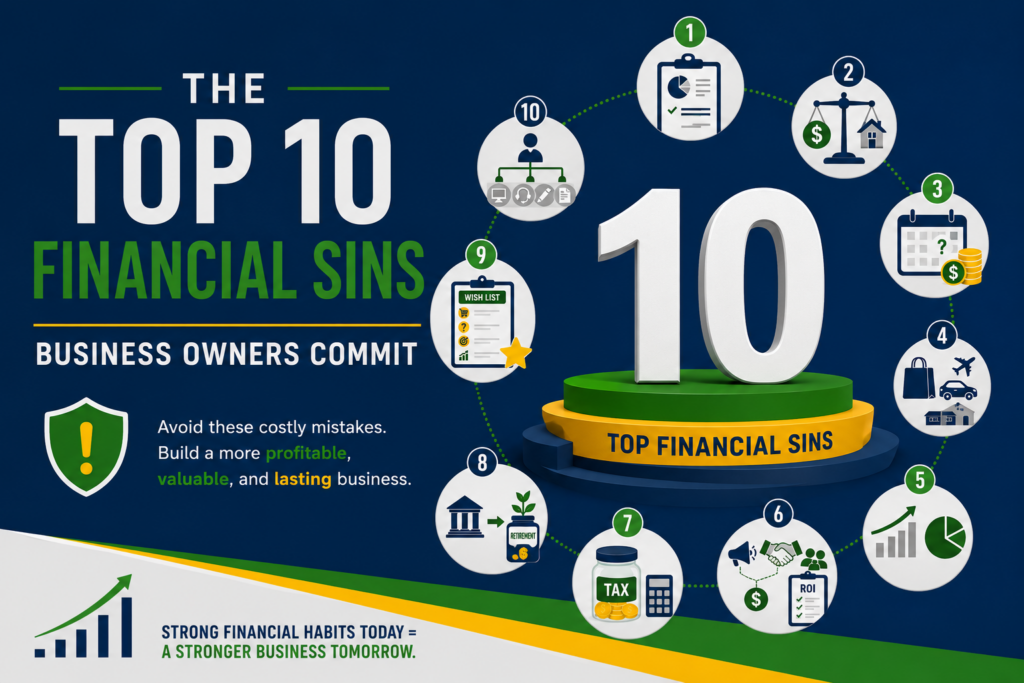
The 10 Deadly Financial Sins of a Profitable Business
- Not Budgeting (Personally and Professionally) or Creating Annual Business Projections
The biggest danger for any business owner is running out of cash. That usually happens when you are not paying attention to the numbers. The foundation of any strong financial system starts with a budget and annual projections for revenue and expenses.
You need to know:
- What it costs to run your business
- What it costs to maintain your lifestyle
- Whether your current income supports both
This is why personal budgeting matters just as much as business budgeting. If your personal lifestyle requires more cash than the business can consistently produce, financial stress eventually follows.
- Mixing Business and Personal Finances
Once you understand your numbers, the next step is creating separation between your business and personal finances. Mixing transactions makes it difficult to understand what your business truly costs to operate and where your money is actually going.
Clear separation creates:
- Better financial visibility
- Cleaner bookkeeping
- Easier tax preparation
- Better business decision-making
If you cannot clearly see the financial health of your business, it becomes much harder to grow it strategically.
- Paying Thyself an Irregular Income
Some business owners simply pay themselves whatever is left over at the end of the month. That approach often creates instability, limits reinvestment opportunities, and can force the business into unnecessary debt.
A profitable business should create a structured compensation system for the owner. Paying yourself consistently creates:
- Predictable personal cash flow
- Better budgeting habits
- More disciplined business management
- Stronger long-term decision-making
You should pay yourself like an owner, not like an afterthought.
- Falling Victim to Business Lifestyle Creep
As business income increases, there is a natural temptation to buy the next fancy tool, software, service, or office upgrade. Because expenses run through the business, owners often justify unnecessary spending by saying, “It’s just a write-off.”
But remember:
You are in business to make money — not simply spend it.
As your business grows, continue to operate economically and intentionally. Every expense should either:
- Increase revenue
- Improve efficiency
- Enhance client experience
- Strengthen enterprise value
Growth without discipline can quietly destroy profitability.
- Measuring Business Health by Revenue Instead of Ratios
Everyone loves hearing impressive revenue numbers, but high sales do not automatically mean you have a healthy business.
Instead of focusing only on top-line revenue, pay attention to the ratios that actually determine financial strength:
- Average revenue per client
- Profit margins
- Expense growth rates
- Client acquisition costs
- Revenue per employee
Is revenue growing faster than expenses?
Are margins improving over time?
Is the business becoming more efficient?
Compare your numbers against industry benchmarks to identify opportunities for improvement and growth.
- Not Setting Aside Money for Sales, Marketing, and Relationships — or Tracking ROI
Growth rarely happens accidentally. It takes intentional investment to create a scalable business.
I have found it valuable for business owners to proactively allocate money toward:
- Marketing
- Networking
- Relationship-building
- SEO
- Social media
- Client experiences
This may mean taking clients and prospects to lunch, attending niche events, or investing in digital marketing strategies.
The key is not just spending money — it is tracking the return on investment. Every dollar allocated toward growth should support a clear strategy and measurable outcome.
- Not Setting Aside Money for Taxes
Taxes get many profitable businesses into trouble. A large unexpected tax bill can derail future business plans and create unnecessary financial stress.
Business owners need a system for consistently setting aside money throughout the year for taxes. Taxes should never feel like a surprise.
Strong businesses prepare for taxes proactively, not reactively.
- Not Automatically Transferring Money Into Retirement Accounts
As a practice owner, it is critical to build wealth outside of your business. Retirement accounts can also create powerful tax advantages while helping you create long-term financial independence.
Some retirement savings vehicles can dramatically accelerate wealth creation, but consistency matters more than perfection. The best system is still automation.
Automatically transferring money from your business account into retirement accounts removes emotion and decision fatigue from the process. It turns wealth-building into a habit rather than an occasional decision.
- Not Keeping a Strategic Business Wish List
You cannot buy everything at once. That is why I recommend every business owner maintain a strategic business wish list.
For every potential purchase, ask:
- What do I want to buy?
- Why do I want to buy it?
- What result do I expect?
- At what stage of growth does this investment make sense?
Regularly review and prioritize the list.
This creates intentional spending decisions instead of emotional ones. Then, when business wins happen, you are not increasing expenses because of lifestyle creep — you are investing strategically in opportunities you identified months earlier.
- Not Creating a “Who Not How” Organization Chart or Outsourcing Plan
If you want to scale your business beyond yourself, you must think ahead about the people and services your future business will require.
I encourage clients to create an organizational chart for the business they want to build — not just the business they currently have. Map out:
- Future roles
- Key responsibilities
- Expected value each role creates
- Which functions should be outsourced
- Which functions should eventually move in-house
This exercise forces you to think strategically about growth, delegation, and scalability.
Many business owners stay stuck because they only think about how to do more work themselves instead of identifying who can help the business grow.
A truly profitable business is not built on revenue alone — it is built on intentional financial systems, disciplined decision-making, and the ability to turn income into long-term wealth. The business owners who create lasting success are not simply the ones who work the hardest; they are the ones who understand their numbers, plan ahead, reinvest strategically, and build a business that supports both their personal life and future goals. Avoiding these financial sins will not guarantee overnight success, but it will dramatically increase the odds that your business becomes not only profitable, but sustainable, scalable, and capable of creating wealth far beyond the income it produces today.
Don't miss our next article
Helping subscribers understand complex financial concepts, investment strategies, retirement planning, and more.


Add Your Heading Text Here

At Deasil Wealth Management, we serve as your personal guide to financial success. From one-on-one guidance to inspiring talks, our mission is to help communities thrive by building wealth.
Quick Links
Get In Touch
© All Rights Reserved.