Stop Giving the IRS an Interest-Free Loan
Learn how strategic W-4 planning can free up cash flow for investing, retirement savings, debt reduction, and business growth.
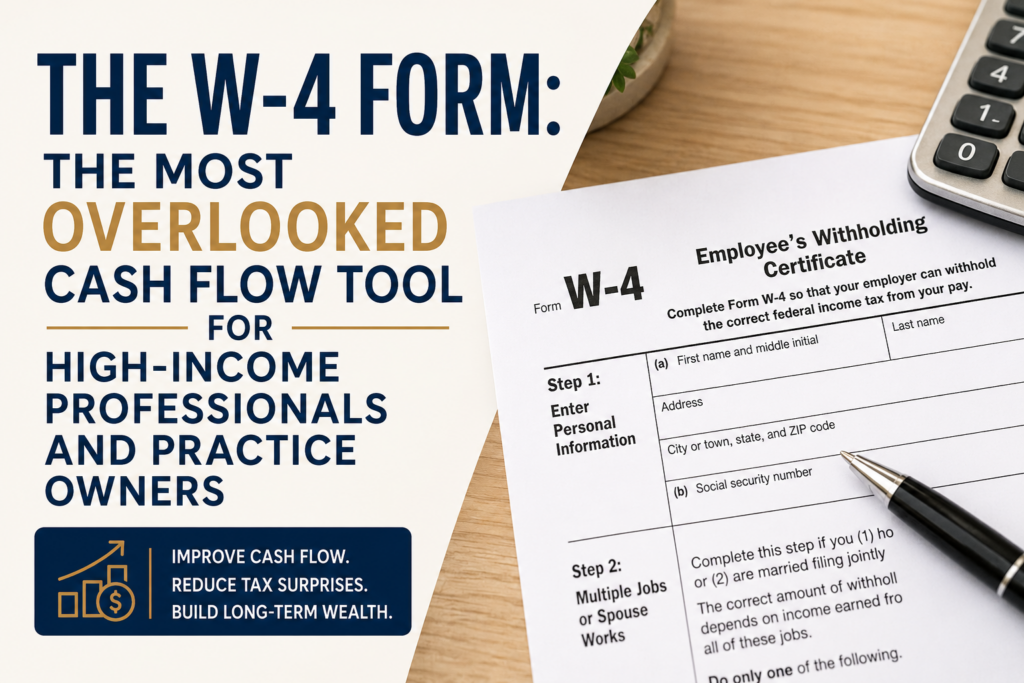
The W-4 Form: The Most Overlooked Cash Flow Tool
When most people hear “W-4 form,” they think of a boring HR document completed on their first day of work and forgotten forever.
But for high-income professionals, practice owners, and families working toward financial independence, the W-4 may be one of the most powerful—and most overlooked—cash flow management tools available.
At Deasil Wealth Management, we often see clients focused on investments, retirement accounts, taxes, and business growth while unknowingly allowing thousands of dollars to flow unnecessarily to the IRS throughout the year.
A properly adjusted W-4 can help improve monthly cash flow, reduce tax surprises, create more intentional financial planning opportunities, and accelerate wealth building.
What Is a W-4 Form?
A W-4, officially called the Employee’s Withholding Certificate, tells your employer how much federal income tax to withhold from each paycheck.
The IRS uses the information on your W-4 to estimate how much tax should be withheld based on your income, family situation, deductions, and other tax factors.
The goal is simple:
- Avoid owing a large amount at tax time
- Avoid receiving an unnecessarily large refund
- Improve cash flow throughout the year
- Reduce the risk of underpayment penalties
While many people celebrate receiving a large tax refund, a refund often means you gave the government an interest-free loan for the entire year.
Why Financial Planners Pay Attention to W-4 Forms
Most people think tax withholding is an accounting issue.
In reality, it is often a financial planning issue.
The amount withheld from your paycheck directly impacts:
- Monthly cash flow
- Retirement savings
- Investment opportunities
- Debt reduction strategies
- Emergency fund growth
- Business reinvestment decisions
For high-income professionals and practice owners, these decisions can significantly impact long-term wealth accumulation.
The Hidden Cost of Large Tax Refunds
Let’s look at an example.
Suppose a therapist, physician, attorney, or practice owner receives a $9,600 tax refund each year.
That equates to approximately:
$9,600 ÷ 12 = $800 per month
That $800 could instead be used to:
- Fund a Roth IRA
- Build a brokerage account
- Increase 401(k) contributions
- Build a cash reserve
- Pay down high-interest debt
- Invest back into a growing practice
A better question may be:
“Would you rather receive a $9,600 refund next April, or have an additional $800 available every month to help achieve your financial goals?”
Major Life Events That Should Trigger a W-4 Review
Many people complete a W-4 once and never revisit it.
However, significant life changes can dramatically alter your tax situation.
You should review your withholding whenever you experience:
Marriage
Two incomes often create tax situations that differ significantly from what either spouse experienced individually.
Divorce
Changes in filing status and household income can impact withholding needs.
Birth or Adoption of a Child
Tax credits and deductions may reduce overall tax liability.
Job Changes
A new salary, bonus structure, or compensation package may require adjustments.
Retirement
New income sources such as pensions, Social Security, and retirement account withdrawals can change withholding needs.
Business Growth
Practice owners experiencing increased profits may need to increase withholding or estimated tax payments.
How Practice Owners Can Use W-4 Planning Strategically
Many practice owners have a combination of:
- W-2 income
- Business income
- K-1 income
- Rental income
- Investment income
This complexity creates planning opportunities.
For example, consider a household where:
- One spouse owns a therapy practice.
- The other spouse works for a hospital or large employer.
Instead of making large quarterly estimated tax payments, it may be possible to increase withholding through the employed spouse’s paycheck.
One unique advantage is that the IRS generally treats withholding as if it were paid evenly throughout the year, even if adjustments occur later in the year.
This can sometimes help reduce the risk of underpayment penalties while simplifying cash flow management.
Coordinating Retirement Contributions and Tax Withholding
A W-4 review becomes particularly important when implementing tax-saving strategies such as:
- Traditional 401(k) contributions
- Solo 401(k) plans
- SEP IRA contributions
- Defined Benefit Plans
- Cash Balance Plans
These strategies may significantly reduce taxable income.
Without updating withholding, some individuals continue having too much tax withheld despite reducing their overall tax liability.
A coordinated review can improve monthly cash flow while maintaining compliance with IRS requirements.
Bonus Income, RSUs, and Variable Compensation
High-income professionals often receive compensation beyond their regular salary.
Examples include:
- Annual bonuses
- Restricted Stock Units (RSUs)
- Commissions
- Profit-sharing distributions
- Equity compensation
Many employers use standard withholding methods that may not accurately reflect the employee’s actual tax bracket.
This frequently results in:
- Large tax bills
- Large refunds
- Cash flow inefficiencies
A proactive withholding review can help create more predictable outcomes.
W-4 Planning and Retirement Transitions
Retirement often introduces multiple new income streams:
- Social Security
- Pension income
- IRA distributions
- Part-time consulting income
- Investment income
Many retirees discover that taxes are not being withheld automatically from all income sources.
Without proper planning, this can create unexpected tax liabilities.
Reviewing withholding before retirement helps create a smoother transition and greater confidence in retirement income planning.
How Often Should You Review Your W-4?
At a minimum, consider reviewing your withholding:
- Annually
- After receiving a raise
- Following a promotion
- After marriage or divorce
- Following the birth of a child
- After major retirement contribution changes
- Following significant investment or business income changes
Think of your W-4 as a living financial planning tool rather than a one-time HR form.
The Financial Planner’s Perspective
At Deasil Wealth Management, we believe financial planning is about helping clients become more intentional with every dollar.
Your W-4 influences the amount of money available to save, invest, spend, and deploy toward your goals every month.
While it may seem like a simple tax form, it can have a meaningful impact on:
- Cash flow management
- Retirement planning
- Tax planning
- Business owner planning
- Wealth accumulation
The goal is not necessarily to maximize your refund.
The goal is to maximize financial efficiency.
Final Thoughts
For many high-income professionals and practice owners, the W-4 is one of the easiest financial planning opportunities to overlook.
Yet a simple review can potentially free up hundreds—or even thousands—of dollars each month that can be redirected toward retirement accounts, investment accounts, debt reduction, or business growth.
If it has been several years since you reviewed your withholding, now may be a good time to revisit it.
A properly calibrated W-4 can help turn tax withholding from an administrative task into a strategic component of your overall financial plan.
Ready for More Financial Clarity?
If you’re a practice owner, therapist, physician, attorney, or high-income professional looking to improve your cash flow, reduce financial stress, and make smarter financial decisions, schedule a complimentary consultation.
CLICK HERE – https://calendly.com/deasil/15min
Don't miss our next article
Helping subscribers understand complex financial concepts, investment strategies, retirement planning, and more.


Add Your Heading Text Here

At Deasil Wealth Management, we serve as your personal guide to financial success. From one-on-one guidance to inspiring talks, our mission is to help communities thrive by building wealth.
Quick Links
Get In Touch
© All Rights Reserved.