For many business owners, preparing for a successful business exit is about more than selling the company. It also means preparing financially, emotionally, and personally for what comes after the sale.
But preparing for a successful business exit involves much more than completing a transaction.
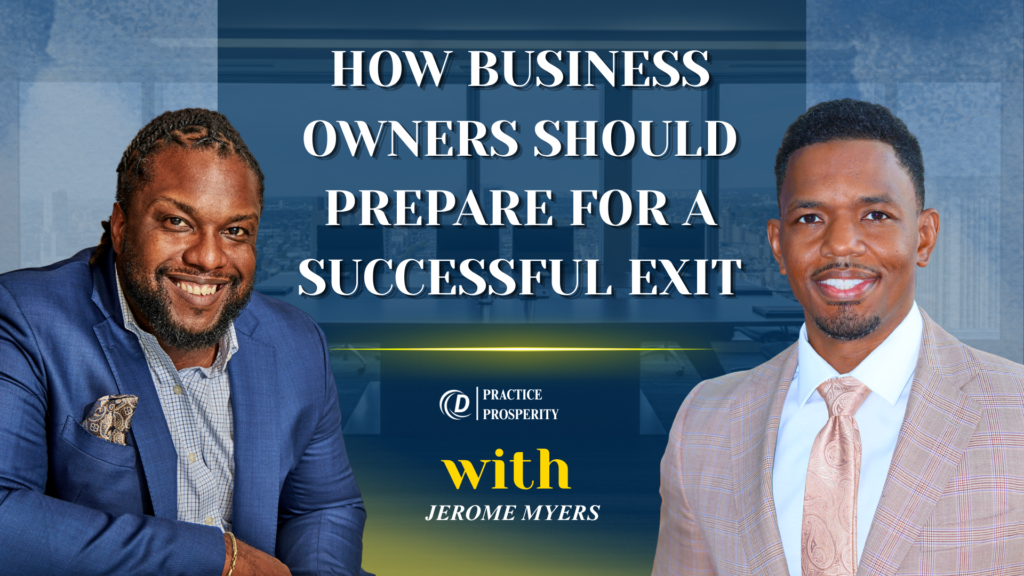
On this episode of Practice Prosperity, Randall Avery speaks with exit planner Jerome Myers about how business owners can prepare both their company and themselves for an eventual exit.
Jerome compares a business exit to a mountain expedition. In his article on the Exit Expedition, he describes the journey in three stages: ascent, summit, and descent. Building the business is the ascent, while selling it and reaching the liquidity event represents the summit. But the summit is not the end of the journey. The descent is where founders must adjust to life after the sale, including changes in identity, relationships, time, and purpose.
That transition can affect a business owner’s identity, health, relationships, finances, time, and sense of purpose.
Start Preparing for a Business Exit Early
Business owners should not wait until they are ready to retire or sell before thinking about an exit.
Jerome explains that good exit planning is closely connected to good business planning. A company that can operate independently of its founder may be easier to transition and can also become a stronger business along the way.
The goal is to gradually reduce the company’s dependence on the owner.
Jerome compares this process to raising a child. Business owners often refer to their company as their “baby,” but a business should not require the same level of attention after many years that it required when it was first created.
As the company matures, the owner’s relationship with it should mature as well.
A business that still requires the founder to solve every problem, approve every decision, and remain constantly available may have grown without becoming truly independent.
For owners who eventually want to sell, retire, or step away, creating that independence is an important part of preparing for a successful business exit.
Build a Business That Can Operate Without You
In the early stages of a business, the owner may need to be involved in nearly every part of the operation.
As the company grows, however, systems, employees, leadership, and processes should begin taking over responsibilities that once depended entirely on the founder.
Jerome explains that failing to make this transition can create a dysfunctional relationship between the owner and the business.
The company begins controlling the owner’s schedule. Vacations become difficult. Major decisions cannot be made without the founder. Problems continually pull the owner back into day-to-day operations.
Preparing for an exit therefore does not begin with finding a buyer.
It begins with creating a company that can continue functioning without constant founder involvement.
Prepare for the Identity Shift After Selling a Business
Financial planning usually receives significant attention during a business sale, but the personal transition can be just as important.
For many founders, the business influences:
- How they spend their days
- Who they interact with
- How they introduce themselves
- The problems they solve
- Where they receive recognition and accomplishment
When the company is sold, many of these things can change at once.
Jerome discusses what can happen when a founder’s sense of significance becomes closely connected to the business. Once the title, employees, customers, responsibilities, and daily challenges are gone, the owner may find themselves asking what comes next.
That is why Jerome encourages founders to think about what they are exiting to, not simply what they are exiting from.
A successful business exit should include preparation for the next stage of life, not only preparation for the sale itself.
Take Care of Your Health Before the Exit
Selling a business can also be physically and mentally demanding.
Jerome identifies self-image, relationships, and work as three major areas that can create stress. Business owners may develop habits for coping with the pressure created by those areas over many years.
An exit can dramatically change all three.
The founder’s professional identity changes, work responsibilities may disappear, and relationships tied to the company can shift.
Jerome encourages business owners to address these areas before the transaction and develop healthier ways of managing stress.
There is also the sale process itself.
Potential buyers and advisors may examine the company closely, question its value, identify weaknesses, and negotiate the terms of the transaction. For a founder experiencing this process for the first time, it can become exhausting.
Preparing physically and mentally is therefore another important part of preparing for a successful business exit.
Build Relationships Outside Your Business
Relationships are another area founders can overlook when preparing to sell.
Many business owners spend a significant amount of their time with employees, partners, advisors, clients, and other people connected to the company.
After an exit, many of those relationships remain connected to the business.
The founder may suddenly find that their personal social circle is much smaller than expected.
Jerome explains that building meaningful relationships outside the company before an exit can help reduce the isolation that may follow a sale.
Financial independence matters, but so does having people and communities with whom to enjoy the next stage of life.
Measure Success by More Than Revenue
When Randall asks Jerome what metric tells him whether his business is successful, Jerome does not choose revenue, profit, or headcount.
He chooses days off.
Revenue and company size can still be useful measurements, but Jerome places greater value on control over his time.
Money can potentially be earned again. Time cannot.
He compares wealth to having unallocated money. In the same way, having more unallocated time can represent another form of wealth.
This creates a different way of evaluating business success.
Instead of only asking how much revenue the company generates, an owner can also ask:
How much control do I have over my time?
A company that produces significant income but requires constant founder involvement may create a very different life from one that gives the owner greater freedom.
For business owners preparing for an exit, that distinction can help clarify what they actually want the business to provide.
Understand the Difference Between Being an Owner and an Operator
Creating a business that can function independently also requires separating the owner’s role from the operator’s role.
Jerome explains that the person performing the CEO or operating role should receive the compensation that would reasonably be required to hire someone else to perform that job.
That cost should be reflected in the company’s financials.
Only after accounting for the cost of operating the company can the owner clearly see what remains as profit.
This matters because a company that generates income only when the founder works inside it is different from a business that can continue producing value after a professional operator has been compensated.
Understanding that distinction can give owners a clearer picture of the company’s profitability and independence before a potential exit.
Reinvest in the Business Like an Investor
Preparing for a successful business exit also means making thoughtful decisions about where company profits are invested.
Jerome recommends approaching reinvestment with the mindset of an investor allocating capital.
During the early stages of the business, significant reinvestment may be necessary while the company establishes product-market fit and develops a profitable way to deliver its products or services.
Once those foundations are established, reinvestment should become more strategic.
Instead of assuming that every business expense is worthwhile, owners should consider what return an investment is expected to produce.
- Will new equipment improve profitability?
- Will purchasing property strengthen the company or simply create another expense?
- Will the investment contribute to greater enterprise value?
An investment that makes sense for one company may not make sense for another.
Jerome’s approach is to create an intentional investment plan and evaluate whether each use of capital actually contributes to the business.
Strategic reinvestment also came up in our conversation with Tania Haddock, who discussed how business owners can make smarter decisions about year-end spending and where to put money back into the company.
A Successful Business Exit Is About More Than Selling
Selling a company can create financial freedom, but completing the transaction does not automatically determine what the next chapter of life will look like.
Preparing for a successful business exit requires attention to both sides of the transition.
The business should become less dependent on its founder.
At the same time, the founder should become less dependent on the business for identity, relationships, purpose, and daily structure.
That means thinking about finances, health, relationships, time, purpose, and how life will change before the transaction takes place.
The goal is not simply to reach the summit and complete the sale.
It is to be prepared for what happens afterward.
As Jerome explains throughout the conversation, business owners should know what they are exiting to, not simply what they are exiting from.
To learn more about Jerome Myers and his approach to helping founders prepare for what comes before, during, and after a business exit, connect with him through Exit to Excellence.
Don't miss our next article
Helping subscribers understand complex financial concepts, investment strategies, retirement planning, and more.


Add Your Heading Text Here

At Deasil Wealth Management, we serve as your personal guide to financial success. From one-on-one guidance to inspiring talks, our mission is to help communities thrive by building wealth.
Quick Links
Get In Touch
© All Rights Reserved.