Managing Business Cash Flow and Building Personal Wealth
How I adapted the Profit First model to help business owners create structure around their business income, personal income, taxes, retirement, and savings.

A Better System for Managing Business Cash Flow and Building Personal Wealth
How I adapted the Profit First model to help business owners create structure around their business income, personal income, taxes, retirement, and savings.
Business Accounts
One of the biggest challenges I see with successful business owners is not necessarily making money.
It is knowing what to do with the money once it comes in.
Revenue hits the business bank account. Payroll is due. Taxes need to be paid. There are software subscriptions, marketing expenses, contractors, and dozens of other things competing for that money.
Then, somewhere in the middle of all of this, the business owner has to figure out how much they can actually pay themselves.
This can lead to a common cycle:
Make money → Pay expenses → Take whatever is left → Hope there is enough for taxes at the end of the year and savings.
I wanted to create a better system.
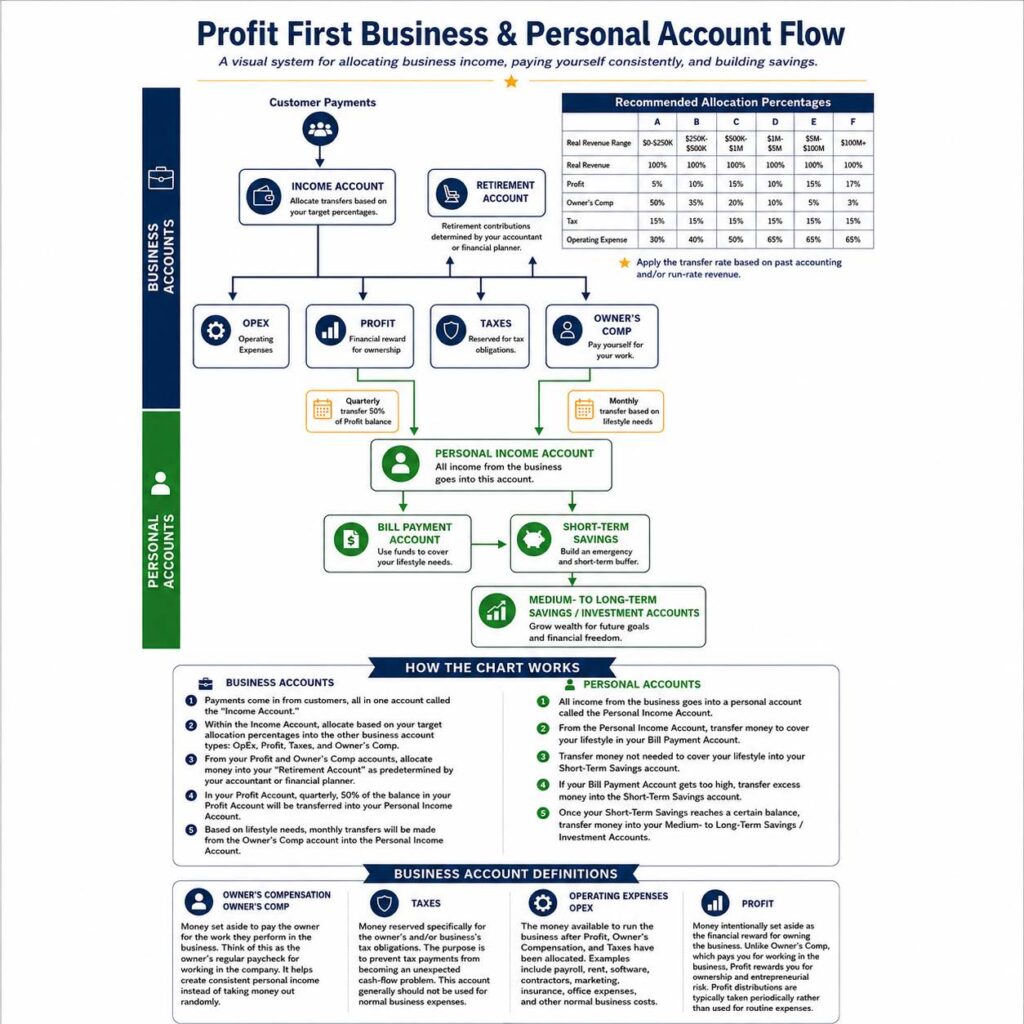
That is why I developed a business and personal account flow based on the principles of the Profit First model. The goal is to give business owners a visual framework for moving money intentionally from the moment it enters the business all the way to building personal wealth outside of the business.
It Starts With One Income Account
The system starts simply.
All customer payments come into one Business Income Account.
Instead of immediately paying bills from this account, the Income Account acts as the distribution point for the business.
Money is periodically transferred from the Income Account into four separate accounts:
- Operating Expenses
- Profit
- Taxes
- Owner’s Compensation
Each dollar coming into the business now has a job.
This is an important shift.
Instead of asking:
“What is left after I pay everything?”
We begin asking:
“How much of every dollar should be allocated toward each priority?”
Operating Expenses: What Does It Really Cost to Run the Business?
The Operating Expense, or OpEx, Account is the money available to actually operate the business.
This includes things such as:
- Payroll
- Rent
- Software
- Contractors
- Marketing
- Insurance
- Office expenses
- Professional services
- Other normal business expenses
One of the principles I like about this system is that operating expenses do not automatically get access to every dollar the business earns.
There is a limit.
This forces the owner to understand what it actually costs to operate the business.
As revenue grows, expenses have a funny way of growing with it. New software gets added. People get hired. Marketing increases. Convenience expenses slowly become permanent expenses.
Separating operating expenses allows you to see whether the business is becoming more profitable as it grows or simply more expensive to operate.
Owner’s Compensation: Pay Yourself for the Work You Do
Your Owner’s Compensation Account is designed to pay you for the work you perform in the business.
Think of this as your paycheck.
One of the mistakes I see business owners make is paying themselves randomly.
They may take $5,000 one month, $12,000 the next month, and almost nothing the following month depending on what is sitting in the business checking account.
That makes managing your personal finances unnecessarily difficult.
Owner’s Compensation is designed to create a more predictable personal income.
You can then establish a consistent monthly transfer from your Owner’s Compensation Account into your Personal Income Account based on your lifestyle needs.
The business and the household begin operating on a system instead of a series of financial decisions made every few weeks.
Profit: Reward Yourself for Owning the Business
Profit and Owner’s Compensation serve two different purposes.
I think this distinction is extremely important.
- Owner’s Compensation pays you for your job.
- Profit pays you for your ownership.
If you stopped working in the business tomorrow and hired someone else to perform your job, that person would need to receive compensation.
But they would not necessarily receive the profit generated by the business.
Profit is the financial reward for building the company, taking the risk, creating the systems, developing the relationships, and owning the enterprise.
Under the framework I created, the Profit Account is allowed to accumulate throughout the quarter.
Then, quarterly, 50% of the Profit Account can be transferred to the owner’s Personal Income Account.
The remaining amount can stay inside the business as additional financial protection and liquidity.
This gives the owner an opportunity to actually experience the financial benefit of owning a profitable company without constantly draining the business.
Taxes: Stop Treating Taxes Like an Emergency
The Tax Account has one purpose:
Set aside money for taxes before you need it.
Tax payments should not be a surprise.
When a percentage of revenue is consistently moved into a separate Tax Account, the business owner can prepare for estimated tax payments and other tax obligations without suddenly needing to find a large amount of cash.
The money has already been separated.
For many business owners, simply removing tax money from the operating account can provide significantly more clarity about how much money is actually available to spend.
The Retirement Account: Turning Business Income Into Long-Term Wealth
This is where I expanded the traditional business cash-flow conversation.
A profitable business is great.
But I don’t believe the business should be the owner’s only retirement plan.
My system includes a Retirement Account that receives contributions from the Profit and Owner’s Compensation portions of the business.
The actual retirement contribution should be determined with your accountant and financial planner based on factors such as:
- Your income
- Business structure
- Retirement plan
- Tax situation
- Cash-flow needs
- Long-term financial goals
The important concept is that retirement savings become part of the system.
You are not waiting until December to see whether there is any money left to contribute.
You are intentionally converting current business income into assets that can eventually support you without requiring you to continue working in the business.
Personal Accounts
Then the Money Moves From the Business to Your Personal Financial System
The business system is only half of the equation.
Once money reaches your Personal Income Account, another allocation process begins.
I designed the personal side of the system around three primary destinations.
- Bill Payment Account
The first priority is funding your lifestyle.
Mortgage or rent, utilities, groceries, insurance, transportation, travel, childcare, and other household expenses should come from your Bill Payment Account.
The goal is to determine what your lifestyle actually costs and consistently fund it. This account should not have more than 2 ½ months work of living expenses
- Short-Term Savings
Money that is not needed for your normal lifestyle can flow into Short-Term Savings.
This might include:
- Emergency reserves
- Upcoming vacations
- Home repairs
- Large purchases
- Annual expenses
- Other short-term goals
There is another important rule built into the system.
If too much money begins accumulating in the Bill Payment Account, the excess should be transferred into Short-Term Savings.
Cash should have a purpose.
- Medium- to Long-Term Savings and Investments
Eventually, your Short-Term Savings Account will reach the amount you have determined is appropriate.
At that point, additional money can begin flowing toward Medium- to Long-Term Savings and Investment Accounts.
This is where business income begins turning into personal wealth.
Depending on the individual, this could include brokerage accounts, retirement accounts, real estate, education savings, or other long-term investments.
The objective is simple:
“Your financial security should gradually become less dependent on your business.”
What Percentage Should Go Into Each Account?
There is no single allocation that works for every business.
Your percentages should be based on your historical accounting, current run-rate revenue, business model, profitability, and personal financial needs.
A business generating $200,000 of revenue will likely have a very different expense structure than one generating $2 million.
The framework provides target allocations based on revenue ranges, but I view those percentages as a starting point for the conversation—not a substitute for understanding your own numbers.
Your accountant can help you understand what has happened historically.
Your financial planner can help determine how the business cash flow connects to your personal goals.
Then you can establish percentages that make sense for your business.
The Bigger Goal Is Financial Clarity
The real value of this system is not having more bank accounts.
The accounts are simply tools.
The real goal is to make your financial decisions easier.
You should know:
- How much you can afford to spend operating the business.
- How much you are paying yourself.
- How much you are reserving for taxes.
- How much profit the business is actually producing.
- How much you are contributing toward retirement.
- How much your household needs to maintain its lifestyle.
- And how much money is consistently moving toward building wealth outside of the business.
- When those decisions become part of a system, you don’t have to reinvent your financial plan every month.
Your Business Should Eventually Serve You
Many business owners spend years serving their businesses.
They invest the money.
They take the risk.
They work the long hours.
They solve the problems.
They hire the employees.
They find the customers.
At some point, the business needs to begin serving the owner.
That does not necessarily mean selling it.
It means using the income the business generates today to create financial security outside of the business for tomorrow.
That is ultimately what I wanted this framework to accomplish.
Not simply better business budgeting.
Not simply more profit.
A system that connects:
Business Revenue → Business Profitability → Personal Income → Retirement → Personal Wealth
Because a successful business is valuable.
But the ability to convert that success into financial independence is even more important.
Want help building a system around your business and personal finances?
At Deasil Wealth Management, I help business and practice owners better understand where their money is going, how much they should be paying themselves, and how to turn business income into long-term personal wealth.
If you would like to discuss how this framework could apply to your business, schedule a conversation with us.
A Successful Business is Valuable
But the ability to convert that success into financial independence is even more important.
Don't miss our next article
Helping subscribers understand complex financial concepts, investment strategies, retirement planning, and more.


Add Your Heading Text Here

At Deasil Wealth Management, we serve as your personal guide to financial success. From one-on-one guidance to inspiring talks, our mission is to help communities thrive by building wealth.
Quick Links
Get In Touch
© All Rights Reserved.